
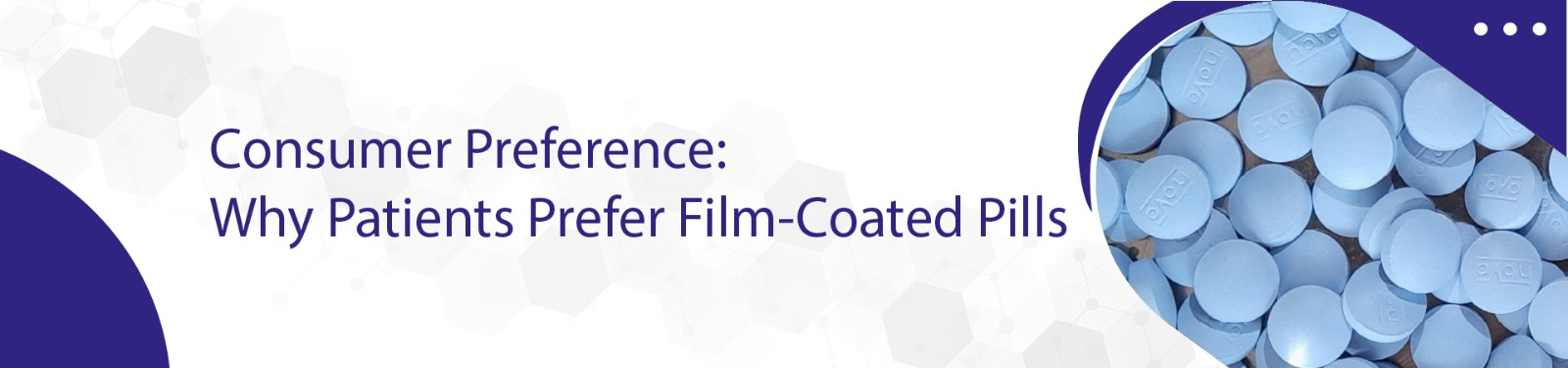
Have you ever really looked at an uncoated tablet? It is chalky, rough. Looking at that pill, it may seem obvious that patients prefer film-coated tablets only for their smooth, polished appearance. Though not wrong, the real value lies in how film coating transforms the entire patient experience.
In this blog, we have explained why exactly patients prefer film-coated pills over the uncoated ones.
What is Film Coating?
A film coating on a tablet refers to the application of a thin, uniform polymer-based layer over a tablet or solid dosage form. It is something that has been a part of solid dosage form development since the 1950s. However, the conversation around it has changed.
Over the years, working closely with tablet coating systems, one thing has become very clear, this few microns thick layer is not just cosmetic afterthought; it is an intersection of patient experience design, pharmacokinetic engineering, and brand identity.
Psychological Comfort:
A coating can be a differential factor between a patient who takes their medication and one who doesn’t. There’s a subtle but powerful psychological aspect at play. A well coated tablet feels less “medical”, less bitter and more manageable. Let us understand this in detail.
- First Impressions Matter:
You only have one chance to make a first impression and for pills often it can mean life or death. Patients may not understand the kinetics behind it. However, they definitely notice how a tablet looks. If a tablet looks shabby, there is less likely chance of patient’s actually having it.
A film-coated tablet has a uniform and elegant finish. This visual refinement builds confidence and trust.
- Improved Swallowability: After impression, the next immediate benefit to patients is ease of swallowing. Ask any healthcare professional and they will surely tell you that dysphagia, or difficulty swallowing, is far more prevalent. In the elderly population, that figure is considerably higher.
An uncoated tablet presents a rough, porous surface to the oropharynx. It drags and sticks. It fragments on contact. For a patient, especially with strong gag reflex, this is enough to make them dread their next dose.
Film coating changes this materially. A well-applied hydroxypropyl methylcellulose (HPMC) or polyvinyl alcohol (PVA)-based film coating creates a smooth, low-friction surface that glides past oral mucosa with significantly less resistance. The tablet doesn’t stick to the tongue. It doesn’t leave a powdery residue. For pediatric and geriatric populations, this can be the difference between compliance and avoidance.
- Taste Masking: Many active pharmaceutical ingredients (APIs) are inherently bitter or unpleasant. This bitter taste creates a genuine adherence barrier. Whenever the patients pick up the pill, the anxiety is already there.
Film coating on tablets provides a physical barrier between the API and oral mucosa. For APIs with significant bitterness (many cardiovascular drugs, several antiretrovirals), this is extremely important.
Achieving reliable taste masking requires more than just applying a coat. Because even a micro pinhole migration of API can lead to an unpleasant taste. Hence, the polymer selection, the plasticizer system, the coating weight gain, and the process parameters during pan coating needs to be precise.
- Easy to identify: Imagine a doctor giving you three different white tablets, one to take in the morning, one in the afternoon, and one in the evening. Sounds confusing? Uncoated tablets are difficult to distinguish between.
Film-coated tablets are just more practical. They are easier to identify through color and imprint. Often the best coated tablets are when the patient recognises their pill without having to read the label.
Chemistry Benefits: Step back from the patient-facing benefits for a moment, because. There are more strong reasons for manufacturers to use film coating on tablets.
- Protection from environmental factors: Many APIs are hygroscopic or photosensitive. In the presence of moisture or UV, their dissolution behaviour and bioavailability changes.
A tablet coating solution acts as a semi-permeable moisture barrier. A tablet that degrades prematurely because the coating was under-engineered is a tablet that fails the patient, regardless of how the clinical data looks.
- Reduces chipping and friability: Uncoated tablets are more prone to mechanical stress during packaging and transport. Coating enhances the tablet’s surface strength and cohesion. This maintains the physical integrity and appearance of the tablet. Less physical defects not only reduces the risk of dose variability but also boost patient confidence in the pill.
- Modified release: Functional film coating does more than protection or presentation. They actively control the pharmacokinetic profile of the drug. For example:
- Enteric coating remains intact in the low-pH environment of the stomach and dissolves in the higher-pH environment of the proximal small intestine
- Extended-release film coating controls the rate and duration of drug release.
Conclusion:
The coating solution for tablets doesn’t solve the adherence crisis, but it removes a barrier that has no reason to exist. Patient preference for tablets with film coating is driven by a combination of comfort, compliance, and consistency. And in a space where therapeutic outcomes depend on adherence, this thin layer plays a far more significant role than it appears.
Novo Excipients development team constantly works on coating formulations that help patients easily consume the tablets. NovoMix Easy and NovoShine are specialized tablet coating and polishing systems developed by Novo Excipients to improve patient comfort. NovoMix Easy is designed specifically to make tablets easier to swallow, while NovoShine enhances tablet gloss and appearance, improving patient acceptance and compliance.
Connect with the NovoExcipients team to experience advanced film coating systems.